The Citizen's Telescope: On the Serious Work of Loving Science
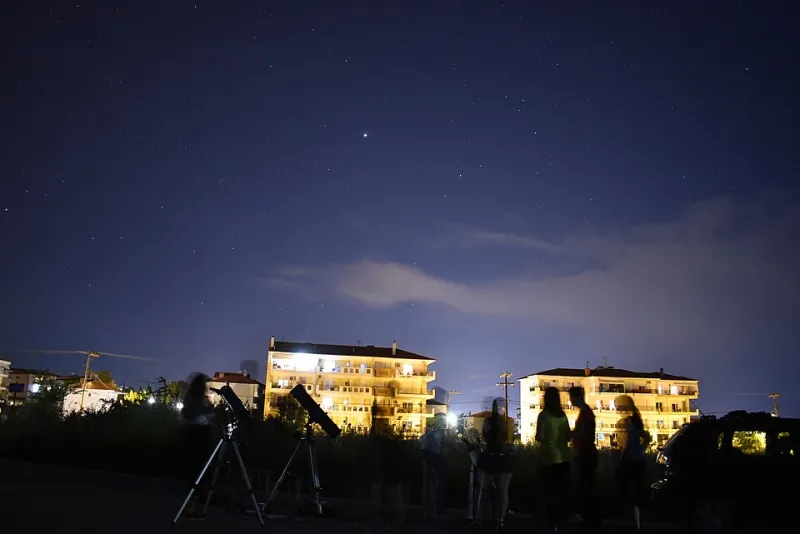
Photo: Annatsach, CC BY 4.0, via Wikimedia Commons
The amateur is not a tourist. That distinction matters more than it once did. In the popular imagination, the amateur scientist is a harmless enthusiast with a telescope in the driveway or a field guide in the glove compartment. In the history of science, the amateur was often something else: an independent observer, a persistent correspondent, a supplier of data that no institution had thought to gather.
The Enlightenment Amateur
The eighteenth-century republic of letters did not draw a sharp line between the credentialed and the curious. Benjamin Franklin's experiments with electricity were conducted outside the university. Joseph Priestley isolated gases while serving a congregation. William Herschel discovered Uranus with a telescope he had built himself. In the American context, naturalists such as John Bartram and John James Audubon worked at the edges of formal institutions and helped create the very idea of an American natural history.
This was not a golden age of untrained enthusiasm. It was an era in which the instruments of inquiry were still accessible to people with time, patience, and a willingness to record what they saw. The amateur was not admired because amateurism was charming. The amateur was useful because observation mattered, and because the republic of letters depended on more observers than any academy could employ.
The Narrowing of the Knower
The professionalization of science brought real gains: standards, training, accountability, and resources. But it also narrowed the definition of who counts as a knower. The rise of the research university, the federal grant, and the peer-reviewed journal made science a career, and careers have gates. Credentialing became a proxy for competence, and funding became a proxy for seriousness. The amateur was gradually reclassified as an audience.
That reclassification is visible in the way citizen science is often organized today. Volunteers count birds, classify galaxies, or transcribe weather records, and their contributions can be genuinely valuable. But too often the relationship is extractive: the institution designs the protocol, the volunteer supplies the labor, and the data flows upward. The amateur is treated as free labor for an app rather than as an inquirer with a question of his or her own.
What Serious Amateur Science Can Do
The case for the amateur is not a case against expertise. It is a case for a wider ecology of inquiry. Professional science is powerful precisely because it is specialized, but specialization can also produce insularity. Amateurs can notice what professionals are trained to ignore. They can sustain long-term observations that outlast grant cycles. They can work in places and on questions that no agency has funded.
American examples are not hard to find. The Audubon Christmas Bird Count has produced more than a century of data on bird populations, gathered by volunteers. Amateur astronomers have discovered comets and monitored variable stars. Community laboratories and maker spaces have given independent researchers access to equipment that would once have been confined to universities. These are not replacements for professional science. They are supplements, checks, and sources of unauthorized curiosity.
A Pro-Inquiry Position
To defend the amateur is to defend the idea that inquiry is not the property of a credential. It is to insist that a serious question, pursued with discipline, deserves a hearing. That does not mean abandoning standards. It means making standards legible, offering credit, and building institutions that can absorb good work from outside the academy without condescending to it.
A 2026 science policy worthy of the name would treat the amateur as a colleague in the oldest sense: someone who loves knowledge enough to pursue it without being paid. The citizen's telescope is not a toy. It is one of the ways a democratic society keeps science from becoming a closed profession.